[[Spring IOC 源码学习总笔记]]
BeanPostProcessor
BeanPostProcessor是 Spring 框架提供的一个扩展点接口,它允许开发者在 Spring 容器完成 Bean 的实例化、依赖注入之后,在初始化阶段的前后“拦截”并自定义 Bean 的逻辑。
package org.springframework.beans.factory.config; import org.springframework.beans.BeansException; import org.springframework.lang.Nullable; public interface BeanPostProcessor { /** * Apply this {@code BeanPostProcessor} to the given new bean instance <i>before</i> any bean * initialization callbacks (like InitializingBean's {@code afterPropertiesSet} * or a custom init-method). The bean will already be populated with property values. * The returned bean instance may be a wrapper around the original. * <p>The default implementation returns the given {@code bean} as-is. * *这个是在 Bean 实例化并且填充属性之后调用, 但是 Bean 中一些生命周期方法如 InitializingBean 接口的 * afterPropertiesSet 方法、自定义的 init-method 方法等都尚未执行,在这些方法执行之前触发 postProcessBeforeInitialization 方法。 * * @param bean the new bean instance * @param beanName the name of the bean * @return the bean instance to use, either the original or a wrapped one; * if {@code null}, no subsequent BeanPostProcessors will be invoked * @throws org.springframework.beans.BeansException in case of errors * @see org.springframework.beans.factory.InitializingBean#afterPropertiesSet */ @Nullable default Object postProcessBeforeInitialization(Object bean, String beanName) throws BeansException { return bean; } /** * Apply this {@code BeanPostProcessor} to the given new bean instance <i>after</i> any bean * initialization callbacks (like InitializingBean's {@code afterPropertiesSet} * or a custom init-method). The bean will already be populated with property values. * The returned bean instance may be a wrapper around the original. * <p>In case of a FactoryBean, this callback will be invoked for both the FactoryBean * instance and the objects created by the FactoryBean (as of Spring 2.0). The * post-processor can decide whether to apply to either the FactoryBean or created * objects or both through corresponding {@code bean instanceof FactoryBean} checks. * <p>This callback will also be invoked after a short-circuiting triggered by a * {@link InstantiationAwareBeanPostProcessor#postProcessBeforeInstantiation} method, * in contrast to all other {@code BeanPostProcessor} callbacks. * <p>The default implementation returns the given {@code bean} as-is. * * 在 InitializingBean 接口的 afterPropertiesSet 和自定义的 init-method 之后触发该方法。 * * @param bean the new bean instance * @param beanName the name of the bean * @return the bean instance to use, either the original or a wrapped one; * if {@code null}, no subsequent BeanPostProcessors will be invoked * @throws org.springframework.beans.BeansException in case of errors * @see org.springframework.beans.factory.InitializingBean#afterPropertiesSet * @see org.springframework.beans.factory.FactoryBean */ @Nullable default Object postProcessAfterInitialization(Object bean, String beanName) throws BeansException { return bean; } } 接口中的两个方法都要将传入的 bean 返回,而不能返回 null,如果返回的是 null 那么我们通过 getBean() 方法将得不到目标对象。
可见:org.springframework.beans.factory.support.AbstractAutowireCapableBeanFactory#applyBeanPostProcessorsBeforeInitialization 的源码调用逻辑
@Deprecated(since = "6.1") @Override public Object applyBeanPostProcessorsBeforeInitialization(Object existingBean, String beanName) throws BeansException { Object result = existingBean; for (BeanPostProcessor processor : getBeanPostProcessors()) { Object current = processor.postProcessBeforeInitialization(result, beanName); if (current == null) { return result; } result = current; } return result; } org.springframework.beans.factory.support.AbstractAutowireCapableBeanFactory#applyBeanPostProcessorsAfterInitialization
@Deprecated(since = "6.1") @Override public Object applyBeanPostProcessorsAfterInitialization(Object existingBean, String beanName) throws BeansException { Object result = existingBean; for (BeanPostProcessor processor : getBeanPostProcessors()) { Object current = processor.postProcessAfterInitialization(result, beanName); if (current == null) { return result; } result = current; } return result; } BeanPostProcessor 的子接口
另外 BeanPostProcessor 粗粒度太大, Spring 还细分一些子接口:
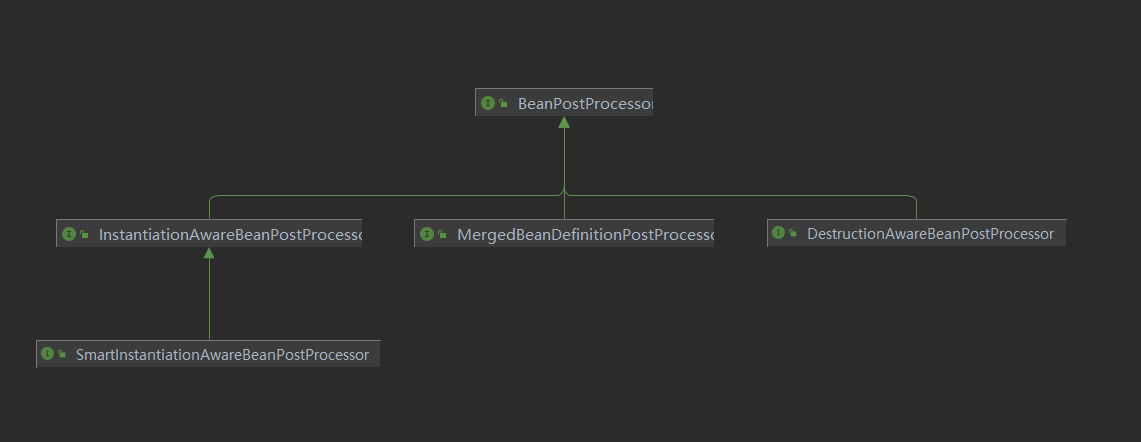
AutowiredAnnotationBeanPostProcessor
@Autowired、@Inject 等就是根据这个回调来实现最终注入依赖的属性的。
public interface InstantiationAwareBeanPostProcessor extends BeanPostProcessor { // BeanPostProcessor 接口方法 @Nullable default Object postProcessBeforeInstantiation(Class<?> beanClass, String beanName) throws BeansException { return null; } // BeanPostProcessor 接口方法 default boolean postProcessAfterInstantiation(Object bean, String beanName) throws BeansException { return true; } /** * Post-process the given property values before the factory applies them * to the given bean. * <p>The default implementation returns the given {@code pvs} as-is. * * 将给定的属性值应用到指定的bean之前进行回调 * 可以用来检查和修改属性,最终返回的PropertyValues会应用到bean中 * `@Autowired、@Resource` 在Spring中 就是根据这个回调来实现最终注入依赖的属性的 * * @param pvs the property values that the factory is about to apply (never {@code null}) * @param bean the bean instance created, but whose properties have not yet been set * @param beanName the name of the bean * @return the actual property values to apply to the given bean (can be the passed-in * PropertyValues instance), or {@code null} to skip property population * @throws org.springframework.beans.BeansException in case of errors * @since 5.1 */ @Nullable default PropertyValues postProcessProperties(PropertyValues pvs, Object bean, String beanName) throws BeansException { return pvs; } } postProcessProperties 在哪里调用呢?
相关源码
org.springframework.beans.factory.support.AbstractAutowireCapableBeanFactory#populateBean 填充Bean属性方法
/** * Populate the bean instance in the given BeanWrapper with the property values * from the bean definition. * @param beanName the name of the bean * @param mbd the bean definition for the bean * @param bw the BeanWrapper with bean instance */ protected void populateBean(String beanName, RootBeanDefinition mbd, @Nullable BeanWrapper bw) { // 验证一下入参 if (bw == null) { if (mbd.hasPropertyValues()) { throw new BeanCreationException( mbd.getResourceDescription(), beanName, "Cannot apply property values to null instance"); } else { // Skip property population phase for null instance. return; } } if (bw.getWrappedClass().isRecord()) { if (mbd.hasPropertyValues()) { throw new BeanCreationException( mbd.getResourceDescription(), beanName, "Cannot apply property values to a record"); } else { // Skip property population phase for records since they are immutable. return; } } // Give any InstantiationAwareBeanPostProcessors the opportunity to modify the // state of the bean before properties are set. This can be used, for example, // to support styles of field injection. /** * 如果是AOP, pointcut, advice相关的, synthetic 会配置为 true */ if (!mbd.isSynthetic() && hasInstantiationAwareBeanPostProcessors()) { for (InstantiationAwareBeanPostProcessor bp : getBeanPostProcessorCache().instantiationAware) { if (!bp.postProcessAfterInstantiation(bw.getWrappedInstance(), beanName)) { return; } } } /** * 包含一个或多个{@link PropertyValue}对象的Holder,通常针对特定目标bean的一次更新 * 可以理解为: 该bean所有属性的描述 */ PropertyValues pvs = (mbd.hasPropertyValues() ? mbd.getPropertyValues() : null); /** * 获取自动注入的方式 */ int resolvedAutowireMode = mbd.getResolvedAutowireMode(); if (resolvedAutowireMode == AUTOWIRE_BY_NAME || resolvedAutowireMode == AUTOWIRE_BY_TYPE) { /** * 该分支处理通过 名称或者类型 注入的属性 * (有注解才会走这个分支) * =============================== */ MutablePropertyValues newPvs = new MutablePropertyValues(pvs); // Add property values based on autowire by name if applicable. if (resolvedAutowireMode == AUTOWIRE_BY_NAME) { /** * 通过名称注入 */ autowireByName(beanName, mbd, bw, newPvs); } // Add property values based on autowire by type if applicable. if (resolvedAutowireMode == AUTOWIRE_BY_TYPE) { /** * 通过类型注入 */ autowireByType(beanName, mbd, bw, newPvs); } pvs = newPvs; } /** * <!> 回调所有 InstantiationAwareBeanPostProcessor#postProcessProperties 方法 * 比如, `@Autowired` 的处理对应实现类: {@link org.springframework.beans.factory.annotation.AutowiredAnnotationBeanPostProcessor} * (作用是: 在工厂将属性值应用到给定bean之前,对它们进行处理) * */ if (hasInstantiationAwareBeanPostProcessors()) { if (pvs == null) { pvs = mbd.getPropertyValues(); } // <!> 回调InstantiationAwareBeanPostProcessor#postProcessProperties 方法 for (InstantiationAwareBeanPostProcessor bp : getBeanPostProcessorCache().instantiationAware) { PropertyValues pvsToUse = bp.postProcessProperties(pvs, bw.getWrappedInstance(), beanName); if (pvsToUse == null) { return; } pvs = pvsToUse; } } .... <!> 回调InstantiationAwareBeanPostProcessor#postProcessProperties 方法
后面注入在: org.springframework.beans.factory.annotation.AutowiredAnnotationBeanPostProcessor#postProcessProperties
@Override public PropertyValues postProcessProperties(PropertyValues pvs, Object bean, String beanName) { InjectionMetadata metadata = findAutowiringMetadata(beanName, bean.getClass(), pvs); try { // 注入 metadata.inject(bean, beanName, pvs); } catch (BeanCreationException ex) { throw ex; } catch (Throwable ex) { throw new BeanCreationException(beanName, "Injection of autowired dependencies failed", ex); } return pvs; } InstantiationAwareBeanPostProcessor & SmartInstantiationAwareBeanPostProcessor
SmartInstantiationAwareBeanPostProcessor 它提供了更高级的Bean实例化控制方法。主要作用在于允许对Bean的实例化过程进行更精细的控制和定制。
public interface SmartInstantiationAwareBeanPostProcessor extends InstantiationAwareBeanPostProcessor { //用来返回目标对象的类型(比如代理对象通过raw class获取proxy type 用于类型匹配) @Nullable default Class<?> predictBeanType(Class<?> beanClass, String beanName) throws BeansException { return null; } //这里提供一个拓展点用来解析获取用来实例化的构造器(比如未通过bean定义构造器以及参数的情况下,会根据这个回调来确定构造器) @Nullable default Constructor<?>[] determineCandidateConstructors(Class<?> beanClass, String beanName) throws BeansException { return null; } //获取要提前暴露的bean的引用,用来支持单例对象的循环引用(一般是bean自身,如果是代理对象则需要取用代理引用) default Object getEarlyBeanReference(Object bean, String beanName) throws BeansException { return bean; } } 相关源码
org.springframework.beans.factory.support.AbstractAutowireCapableBeanFactory#createBean(java.lang.String, org.springframework.beans.factory.support.RootBeanDefinition, java.lang.Object[])
@Override protected Object createBean(String beanName, RootBeanDefinition mbd, @Nullable Object[] args) throws BeanCreationException { if (logger.isTraceEnabled()) { logger.trace("Creating instance of bean '" + beanName + "'"); } RootBeanDefinition mbdToUse = mbd; /** * 1. 解析到 BeanDefinition 的 Class */ Class<?> resolvedClass = resolveBeanClass(mbd, beanName); /** * 2. 创建BeanDefinition 复制一份 RootBeanDefinition */ if (resolvedClass != null && !mbd.hasBeanClass() && mbd.getBeanClassName() != null) { mbdToUse = new RootBeanDefinition(mbd); mbdToUse.setBeanClass(resolvedClass); } // Prepare method overrides. try { /** * 3. 准备和验证 lookup-method 和 replace-method; * 注意: 这里只是标记, 真正处理是在实例化时, 选择策略生成一个CgLib的代理对象 {@link org.springframework.beans.factory.support.CglibSubclassingInstantiationStrategy} * 关于它们的作用见笔记 [[Spring lookup-method 和 replace-method.md]] */ mbdToUse.prepareMethodOverrides(); } catch (BeanDefinitionValidationException ex) { throw new BeanDefinitionStoreException(mbdToUse.getResourceDescription(), beanName, "Validation of method overrides failed", ex); } try { /** * 给 BeanPostProcessors 一个返回代理实例的机会; * 注意, 这里的逻辑: * 如果其 BeanPostProcessors的子接口返回不为null, 则直接使用这个bean实例返回了, 不走 doCreateBean流程了 * (注意的注意! 如果有用户自定义的拦截创建, 甚至优先Spring的AOP代理创建) */ Object bean = resolveBeforeInstantiation(beanName, mbdToUse); if (bean != null) { return bean; } } catch (Throwable ex) { throw new BeanCreationException(mbdToUse.getResourceDescription(), beanName, "BeanPostProcessor before instantiation of bean failed", ex); } org.springframework.beans.factory.support.AbstractAutowireCapableBeanFactory#resolveBeforeInstantiation
protected Object resolveBeforeInstantiation(String beanName, RootBeanDefinition mbd) { Object bean = null; if (!Boolean.FALSE.equals(mbd.beforeInstantiationResolved)) { // Make sure bean class is actually resolved at this point. // 如果是合成的(mbd是AOP的时候,为true)并且实现 InstantiationAwareBeanPostProcessor 接口 if (!mbd.isSynthetic() && hasInstantiationAwareBeanPostProcessors()) { Class<?> targetType = determineTargetType(beanName, mbd); if (targetType != null) { // 使用 InstantiationAwareBeanPostProcessor接口 生成的 bean 返回 bean = applyBeanPostProcessorsBeforeInstantiation(targetType, beanName); if (bean != null) { bean = applyBeanPostProcessorsAfterInitialization(bean, beanName); } } } mbd.beforeInstantiationResolved = (bean != null); } return bean; } DestructionAwareBeanPostProcessor
DestructionAwareBeanPostProcessor 它允许在Bean被销毁之前(例如,容器关闭或特定作用域的Bean销毁)执行一些操作。
org.springframework.beans.factory.config.DestructionAwareBeanPostProcessor
public interface DestructionAwareBeanPostProcessor extends BeanPostProcessor { //这里实现销毁对象的逻辑 void postProcessBeforeDestruction(Object bean, String beanName) throws BeansException; //判断是否需要处理这个对象的销毁 default boolean requiresDestruction(Object bean) { return true; } } MergedBeanDefinitionPostProcessor
MergedBeanDefinitionPostProcessor 算是整个 BeanPostProcessor 家族中比较另类的一个接口了,它虽然是 BeanPostProcessor,但是却可以处理 BeanDefinition。
MergedBeanDefinitionPostProcessor 介入的时机就是 Bean 创建成功之后,Bean 中各个属性填充之前。
相关源码
org.springframework.beans.factory.support.AbstractAutowireCapableBeanFactory#doCreateBean
protected Object doCreateBean(String beanName, RootBeanDefinition mbd, @Nullable Object[] args) throws BeanCreationException { // Instantiate the bean. BeanWrapper instanceWrapper = null; if (mbd.isSingleton()) { instanceWrapper = this.factoryBeanInstanceCache.remove(beanName); } if (instanceWrapper == null) { /** * 1. 真正在jvm层面实例化对象; * 1.1 如果该 BeanDefinition 有配置 instanceSupplier属性(java.util.function.Supplier), * 将使用其Supplier#get方法的返回, 作为实例对象 * 1.2 如果该 BeanDefinition 有配置 factory-method 将使用该方法返回的, 作为实例对象 * 这里这里包括'静态工厂'和'实例工厂'的处理(通过bd的factoryBeanName 进行判断, 如果存在则是'实例工厂') * 1.3 使用反射实例化, 根据策略实例化Bean对象 {@link org.springframework.beans.factory.support.SimpleInstantiationStrategy} * - 使用有参构造函数注入,创建 (new) * - 使用无参构造函数创建 (new) * - 工厂方法实例化 ('静态工厂' '实例工厂' ) * `<bean factory-bean="bookFactoryBean" factory-method="getBook()"/>` * 静态工厂: factory-bean 若是 全限定类名 则使用 BookFactoryBean::getBook 的静态方法返回的对象 * 实例工厂: factory-bean 若是 bean 名 则使用该实例方法返回的对象 * {@link AbstractAutowireCapableBeanFactory#createBeanInstance(java.lang.String, org.springframework.beans.factory.support.RootBeanDefinition, java.lang.Object[])} * 2. 用BeanWrapper 包装原始bean (装饰模式) * {@link org.springframework.beans.factory.support.AbstractAutowireCapableBeanFactory#instantiateBean(java.lang.String, org.springframework.beans.factory.support.RootBeanDefinition)} * */ instanceWrapper = createBeanInstance(beanName, mbd, args); } /** * 获取 BeanWrapper中的原始 Bean 实例 */ Object bean = instanceWrapper.getWrappedInstance(); /** * 获取Bean Class类型 */ Class<?> beanType = instanceWrapper.getWrappedClass(); if (beanType != NullBean.class) { mbd.resolvedTargetType = beanType; } // Allow post-processors to modify the merged bean definition. synchronized (mbd.postProcessingLock) { if (!mbd.postProcessed) { try { /** * 实例化完了, 处理 MergedBeanDefinitionPostProcessor 的接口回调 */ applyMergedBeanDefinitionPostProcessors(mbd, beanType, beanName); } catch (Throwable ex) { throw new BeanCreationException(mbd.getResourceDescription(), beanName, "Post-processing of merged bean definition failed", ex); } mbd.markAsPostProcessed(); } } // Eagerly cache singletons to be able to resolve circular references // even when triggered by lifecycle interfaces like BeanFactoryAware. boolean earlySingletonExposure = (mbd.isSingleton() && this.allowCircularReferences && isSingletonCurrentlyInCreation(beanName)); if (earlySingletonExposure) { if (logger.isTraceEnabled()) { logger.trace("Eagerly caching bean '" + beanName + "' to allow for resolving potential circular references"); } addSingletonFactory(beanName, () -> getEarlyBeanReference(beanName, mbd, bean)); } // Initialize the bean instance. Object exposedObject = bean; try { /** * 填充属性 */ populateBean(beanName, mbd, instanceWrapper); exposedObject = initializeBean(beanName, exposedObject, mbd); } ..... 处理 init-method, @PostConstruct, @PreDestroy
对应子类 org.springframework.beans.factory.annotation.InitDestroyAnnotationBeanPostProcessor
注意: 这里只是查询到封装为元信息保存到 BeanDefinition, 还不会调用
org.springframework.beans.factory.annotation.InitDestroyAnnotationBeanPostProcessor#findLifecycleMetadata(org.springframework.beans.factory.support.RootBeanDefinition, java.lang.Class<?>)
private LifecycleMetadata findLifecycleMetadata(RootBeanDefinition beanDefinition, Class<?> beanClass) { /** 查找相应的注解方法信息, 封装为 LifecycleMetadata 元数据(使用集合存起来包含: initMethods 列表,destroyMethods列表...) */ LifecycleMetadata metadata = findLifecycleMetadata(beanClass); /** 再将这些 LifecycleMetadata 元数据, 注册(修改)到 BeanDefinition 中 beanDefinition.registerExternallyManagedInitMethod(methodIdentifier); beanDefinition.registerExternallyManagedDestroyMethod(methodIdentifier); **/ metadata.checkInitDestroyMethods(beanDefinition); return metadata; } 处理 @Autowired
对应子类 org.springframework.beans.factory.annotation.AutowiredAnnotationBeanPostProcessor
注意: 这里只是查询到封装为元信息保存到 BeanDefinition, 还不会调用
雷同的逻辑
org.springframework.beans.factory.annotation.AutowiredAnnotationBeanPostProcessor#findInjectionMetadata
private InjectionMetadata findInjectionMetadata(String beanName, Class<?> beanType, RootBeanDefinition beanDefinition) { // 查找 注解方法信息, 封装为元数据对象 InjectionMetadata metadata = findAutowiringMetadata(beanName, beanType, null); // 注册(修改)到 BeanDefinition 中 metadata.checkConfigMembers(beanDefinition); return metadata; }