

前言
今天我们来聊聊一个即将改变我们编程习惯的新特性——ScopedValue。
有些小伙伴在工作中,一提到线程内数据传递就想到ThreadLocal,但真正用起来却遇到各种坑:内存泄漏、数据污染、性能问题等等。
其实,ScopedValue就像ThreadLocal的升级版,既保留了优点,又解决了痛点。
我们一起聊聊ScopedValue的优势和用法,希望对你会有所帮助。
一、ThreadLocal的痛点
在介绍ScopedValue之前,我们先回顾一下ThreadLocal的常见问题。
有些小伙伴可能会想:"ThreadLocal用得好好的,为什么要换?"
其实,ThreadLocal在设计上存在一些固有缺陷。
ThreadLocal的内存泄漏问题
为了更直观地理解ThreadLocal的内存泄漏问题,我画了一个内存泄漏的示意图:
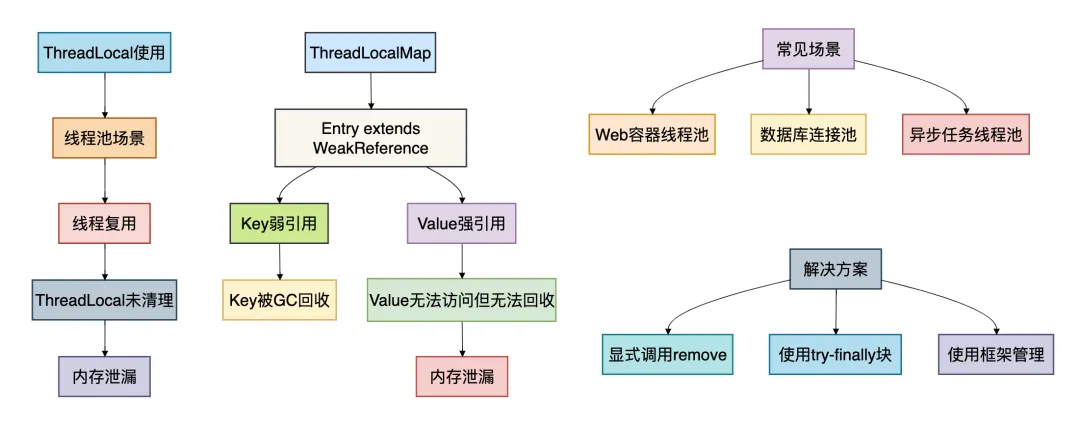
ThreadLocal的典型问题代码
/** * ThreadLocal典型问题演示 */ public class ThreadLocalProblems { private static final ThreadLocal<UserContext> userContext = new ThreadLocal<>(); private static final ThreadLocal<Connection> connectionHolder = new ThreadLocal<>(); /** * 问题1:内存泄漏 - 忘记调用remove() */ public void processRequest(HttpServletRequest request) { // 设置用户上下文 UserContext context = new UserContext(request.getHeader("X-User-Id")); userContext.set(context); try { // 业务处理 businessService.process(); // 问题:忘记调用 userContext.remove() // 在线程池中,这个线程被重用时,还会保留之前的用户信息 } catch (Exception e) { // 异常处理 } } /** * 问题2:数据污染 - 线程复用导致数据混乱 */ public void processMultipleRequests() { // 线程池处理多个请求 ExecutorService executor = Executors.newFixedThreadPool(5); for (int i = 0; i < 10; i++) { final int userId = i; executor.submit(() -> { // 设置用户上下文 userContext.set(new UserContext("user_" + userId)); try { // 模拟业务处理 Thread.sleep(100); // 问题:如果线程被复用,这里可能读取到错误的用户信息 String currentUser = userContext.get().getUserId(); System.out.println("处理用户: " + currentUser); } catch (InterruptedException e) { Thread.currentThread().interrupt(); } finally { // 即使调用remove,也可能因为异常跳过 userContext.remove(); // 不保证一定执行 } }); } executor.shutdown(); } /** * 问题3:继承性问题 - 子线程无法继承父线程数据 */ public void parentChildThreadProblem() { userContext.set(new UserContext("parent_user")); Thread childThread = new Thread(() -> { // 这里获取不到父线程的ThreadLocal值 UserContext context = userContext.get(); // null System.out.println("子线程用户: " + context); // 输出null // 需要手动传递数据 }); childThread.start(); } /** * 问题4:性能问题 - 大量ThreadLocal影响性能 */ public void performanceProblem() { long startTime = System.currentTimeMillis(); for (int i = 0; i < 100000; i++) { ThreadLocal<String> tl = new ThreadLocal<>(); tl.set("value_" + i); String value = tl.get(); tl.remove(); } long endTime = System.currentTimeMillis(); System.out.println("ThreadLocal操作耗时: " + (endTime - startTime) + "ms"); } } /** * 用户上下文 */ class UserContext { private final String userId; private final long timestamp; public UserContext(String userId) { this.userId = userId; this.timestamp = System.currentTimeMillis(); } public String getUserId() { return userId; } public long getTimestamp() { return timestamp; } @Override public String toString() { return "UserContext{userId='" + userId + "', timestamp=" + timestamp + "}"; } } ThreadLocal问题的根本原因
- 生命周期管理复杂:需要手动调用set/remove,容易遗漏
- 内存泄漏风险:线程池中线程复用,Value无法被GC
- 继承性差:子线程无法自动继承父线程数据
- 性能开销:ThreadLocalMap的哈希表操作有开销
有些小伙伴可能会问:"我们用InheritableThreadLocal不就能解决继承问题了吗?"
我的经验是:InheritableThreadLocal只是缓解了问题,但带来了新的复杂度,而且性能更差。
二、ScopedValue:新一代线程局部变量
ScopedValue是Java 20中引入的预览特性,在Java 21中成为正式特性。
它旨在解决ThreadLocal的痛点,提供更安全、更高效的线程内数据传递方案。
ScopedValue的核心设计理念
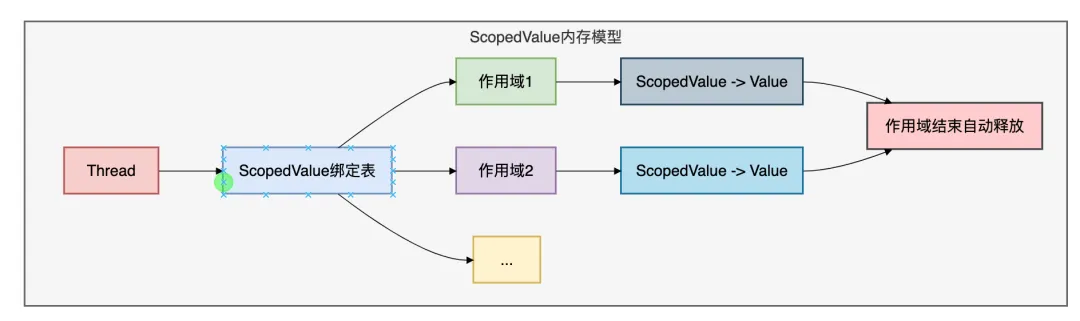
为了更直观地理解ScopedValue的工作原理,我画了一个ScopedValue的架构图:
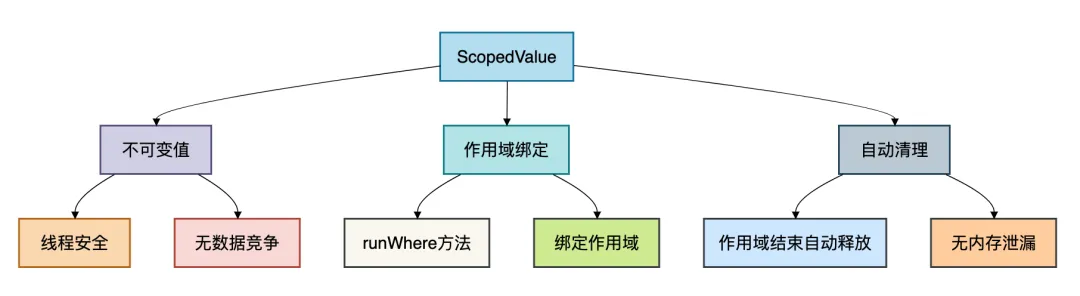
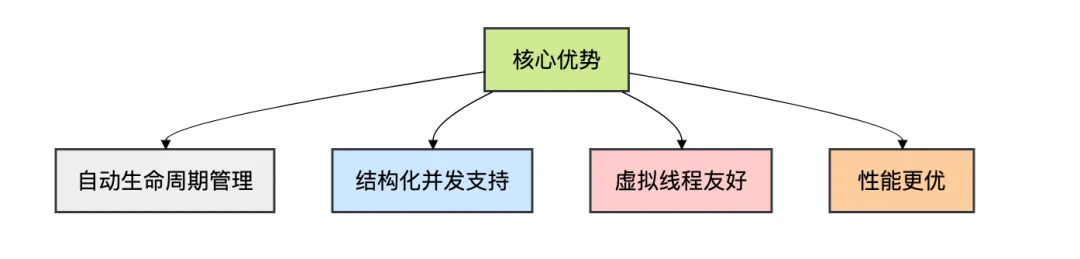
ScopedValue的核心优势:
ScopedValue基础用法
/** * ScopedValue基础用法演示 */ public class ScopedValueBasics { // 1. 定义ScopedValue(相当于ThreadLocal) private static final ScopedValue<UserContext> USER_CONTEXT = ScopedValue.newInstance(); private static final ScopedValue<Connection> DB_CONNECTION = ScopedValue.newInstance(); private static final ScopedValue<String> REQUEST_ID = ScopedValue.newInstance(); /** * 基础用法:在作用域内使用ScopedValue */ public void basicUsage() { UserContext user = new UserContext("user_123"); // 在作用域内绑定值 ScopedValue.runWhere(USER_CONTEXT, user, () -> { // 在这个作用域内,USER_CONTEXT.get()返回user_123 System.out.println("当前用户: " + USER_CONTEXT.get().getUserId()); // 可以嵌套使用 ScopedValue.runWhere(REQUEST_ID, "req_456", () -> { System.out.println("请求ID: " + REQUEST_ID.get()); System.out.println("用户: " + USER_CONTEXT.get().getUserId()); }); // 这里REQUEST_ID已经超出作用域,获取会抛出异常 }); // 这里USER_CONTEXT已经超出作用域 } /** * 带返回值的作用域 */ public String scopedValueWithReturn() { UserContext user = new UserContext("user_789"); // 使用callWhere获取返回值 String result = ScopedValue.callWhere(USER_CONTEXT, user, () -> { // 业务处理 String userId = USER_CONTEXT.get().getUserId(); return "处理用户: " + userId; }); return result; } /** * 多个ScopedValue同时使用 */ public void multipleScopedValues() { UserContext user = new UserContext("user_multi"); Connection conn = createConnection(); // 同时绑定多个ScopedValue ScopedValue.runWhere( ScopedValue.where(USER_CONTEXT, user) .where(DB_CONNECTION, conn) .where(REQUEST_ID, "multi_req"), () -> { // 在这个作用域内可以访问所有绑定的值 processBusinessLogic(); } ); // 作用域结束后自动清理 } /** * 异常处理示例 */ public void exceptionHandling() { UserContext user = new UserContext("user_exception"); try { ScopedValue.runWhere(USER_CONTEXT, user, () -> { // 业务处理 processBusinessLogic(); // 如果抛出异常,作用域也会正常结束 if (someCondition()) { throw new RuntimeException("业务异常"); } }); } catch (RuntimeException e) { // 异常处理 System.out.println("捕获异常: " + e.getMessage()); } // 即使发生异常,USER_CONTEXT也会自动清理 } private Connection createConnection() { // 创建数据库连接 return null; } private void processBusinessLogic() { // 业务逻辑处理 UserContext user = USER_CONTEXT.get(); System.out.println("处理业务逻辑,用户: " + user.getUserId()); } private boolean someCondition() { return Math.random() > 0.5; } } 三、ScopedValue vs ThreadLocal:全面对比
有些小伙伴可能还想知道ScopedValue到底比ThreadLocal强在哪里。
让我们通过详细的对比来看看。
3.1 内存管理对比
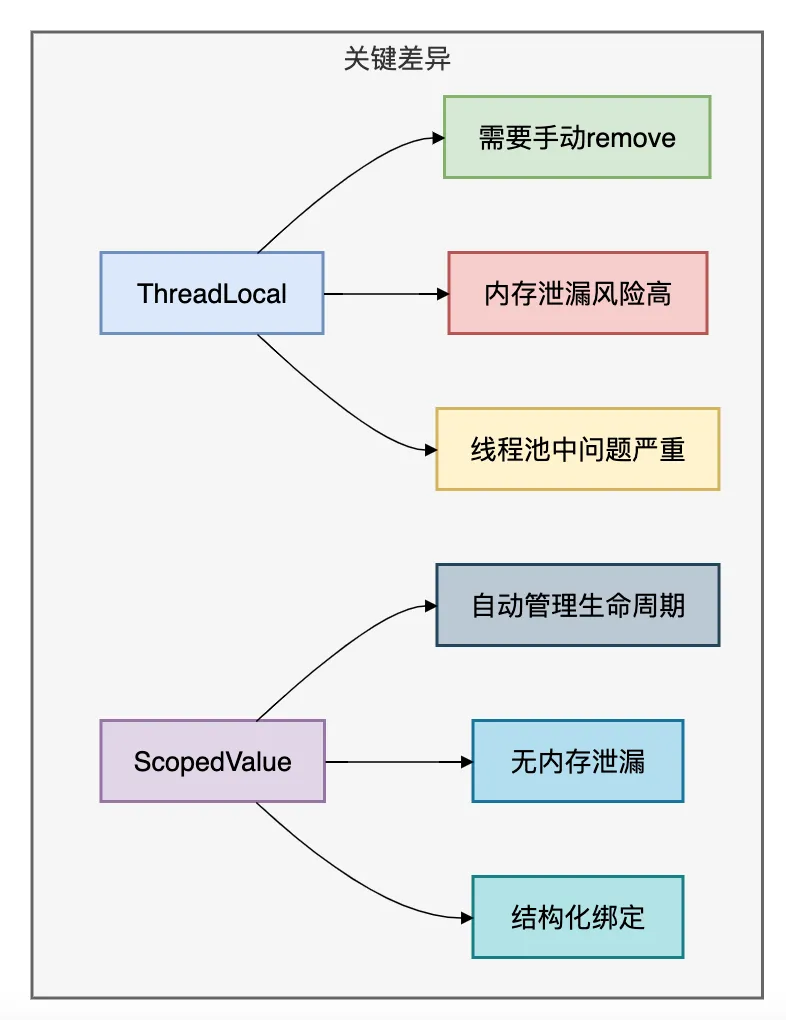
为了更直观地理解两者的内存管理差异,我画了几张图做对比。
ThreadLocal的内存模型图:
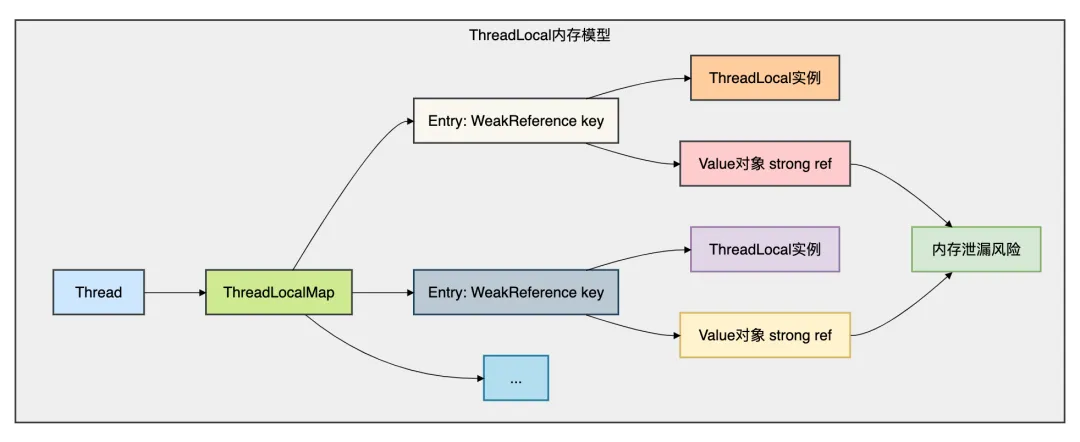
ScopedValue的内存模型图:
二者的关键差异如下图:
3.2 代码对比示例
/** * ThreadLocal vs ScopedValue 对比演示 */ public class ThreadLocalVsScopedValue { // ThreadLocal方式 private static final ThreadLocal<UserContext> TL_USER_CONTEXT = new ThreadLocal<>(); private static final ThreadLocal<Connection> TL_CONNECTION = new ThreadLocal<>(); // ScopedValue方式 private static final ScopedValue<UserContext> SV_USER_CONTEXT = ScopedValue.newInstance(); private static final ScopedValue<Connection> SV_CONNECTION = ScopedValue.newInstance(); /** * ThreadLocal方式 - 传统实现 */ public void processRequestThreadLocal(HttpServletRequest request) { // 设置上下文 UserContext userContext = new UserContext(request.getHeader("X-User-Id")); TL_USER_CONTEXT.set(userContext); Connection conn = null; try { // 获取数据库连接 conn = dataSource.getConnection(); TL_CONNECTION.set(conn); // 业务处理 processBusinessLogic(); } catch (SQLException e) { // 异常处理 handleException(e); } finally { // 必须手动清理 - 容易忘记! TL_USER_CONTEXT.remove(); TL_CONNECTION.remove(); // 关闭连接 if (conn != null) { try { conn.close(); } catch (SQLException e) { // 日志记录 } } } } /** * ScopedValue方式 - 现代实现 */ public void processRequestScopedValue(HttpServletRequest request) { UserContext userContext = new UserContext(request.getHeader("X-User-Id")); // 使用try-with-resources管理连接 try (Connection conn = dataSource.getConnection()) { // 在作用域内执行,自动管理生命周期 ScopedValue.runWhere( ScopedValue.where(SV_USER_CONTEXT, userContext) .where(SV_CONNECTION, conn), () -> { // 业务处理 processBusinessLogic(); } ); // 作用域结束后自动清理,无需手动remove } catch (SQLException e) { handleException(e); } } /** * 业务逻辑处理 - 两种方式对比 */ private void processBusinessLogic() { // ThreadLocal方式 - 需要处理null值 UserContext tlUser = TL_USER_CONTEXT.get(); if (tlUser == null) { throw new IllegalStateException("用户上下文未设置"); } Connection tlConn = TL_CONNECTION.get(); if (tlConn == null) { throw new IllegalStateException("数据库连接未设置"); } // ScopedValue方式 - 在作用域内保证不为null UserContext svUser = SV_USER_CONTEXT.get(); // 不会为null Connection svConn = SV_CONNECTION.get(); // 不会为null // 实际业务处理... System.out.println("处理用户: " + svUser.getUserId()); } /** * 线程池场景对比 */ public void threadPoolComparison() { ExecutorService executor = Executors.newFixedThreadPool(5); // ThreadLocal方式 - 容易出问题 for (int i = 0; i < 10; i++) { final int userId = i; executor.submit(() -> { TL_USER_CONTEXT.set(new UserContext("user_" + userId)); try { processBusinessLogic(); } finally { TL_USER_CONTEXT.remove(); // 容易忘记或异常跳过 } }); } // ScopedValue方式 - 更安全 for (int i = 0; i < 10; i++) { final int userId = i; executor.submit(() -> { UserContext user = new UserContext("user_" + userId); ScopedValue.runWhere(SV_USER_CONTEXT, user, () -> { processBusinessLogic(); // 自动管理生命周期 }); }); } executor.shutdown(); } private Connection getConnectionFromTL() { return TL_CONNECTION.get(); } private DataSource dataSource = null; // 模拟数据源 private void handleException(SQLException e) {} // 异常处理 } 3.3 性能对比测试
/** * 性能对比测试 */ @BenchmarkMode(Mode.AverageTime) @OutputTimeUnit(TimeUnit.MICROSECONDS) @State(Scope.Thread) public class PerformanceComparison { private static final ThreadLocal<String> THREAD_LOCAL = new ThreadLocal<>(); private static final ScopedValue<String> SCOPED_VALUE = ScopedValue.newInstance(); private static final int ITERATIONS = 100000; /** * ThreadLocal性能测试 */ @Benchmark public void threadLocalPerformance() { for (int i = 0; i < ITERATIONS; i++) { THREAD_LOCAL.set("value_" + i); String value = THREAD_LOCAL.get(); THREAD_LOCAL.remove(); } } /** * ScopedValue性能测试 */ @Benchmark public void scopedValuePerformance() { for (int i = 0; i < ITERATIONS; i++) { ScopedValue.runWhere(SCOPED_VALUE, "value_" + i, () -> { String value = SCOPED_VALUE.get(); // 自动清理,无需remove }); } } /** * 实际场景性能测试 */ public void realScenarioTest() { long tlStart = System.nanoTime(); // ThreadLocal场景 THREAD_LOCAL.set("initial_value"); for (int i = 0; i < ITERATIONS; i++) { String current = THREAD_LOCAL.get(); THREAD_LOCAL.set(current + "_" + i); } THREAD_LOCAL.remove(); long tlEnd = System.nanoTime(); // ScopedValue场景 long svStart = System.nanoTime(); ScopedValue.runWhere(SCOPED_VALUE, "initial_value", () -> { String current = SCOPED_VALUE.get(); for (int i = 0; i < ITERATIONS; i++) { // ScopedValue是不可变的,需要重新绑定 String newValue = current + "_" + i; ScopedValue.runWhere(SCOPED_VALUE, newValue, () -> { // 嵌套作用域 String nestedValue = SCOPED_VALUE.get(); }); } }); long svEnd = System.nanoTime(); System.out.printf("ThreadLocal耗时: %d ns%n", tlEnd - tlStart); System.out.printf("ScopedValue耗时: %d ns%n", svEnd - svStart); } } 四、ScopedValue高级特性
有些小伙伴掌握了基础用法后,还想了解更高级的特性。
ScopedValue确实提供了很多强大的功能。
4.1 结构化并发支持
ScopedValue与虚拟线程和结构化并发完美配合:
/** * ScopedValue与结构化并发 */ public class StructuredConcurrencyExample { private static final ScopedValue<UserContext> USER_CONTEXT = ScopedValue.newInstance(); private static final ScopedValue<RequestInfo> REQUEST_INFO = ScopedValue.newInstance(); /** * 结构化并发中的ScopedValue使用 */ public void structuredConcurrencyWithScopedValue() throws Exception { UserContext user = new UserContext("structured_user"); RequestInfo request = new RequestInfo("req_123", System.currentTimeMillis()); try (var scope = new StructuredTaskScope.ShutdownOnFailure()) { ScopedValue.runWhere( ScopedValue.where(USER_CONTEXT, user) .where(REQUEST_INFO, request), () -> { // 在作用域内提交子任务 Future<String> userTask = scope.fork(this::fetchUserData); Future<String> orderTask = scope.fork(this::fetchOrderData); Future<String> paymentTask = scope.fork(this::fetchPaymentData); try { // 等待所有任务完成 scope.join(); scope.throwIfFailed(); // 处理结果 String userData = userTask.resultNow(); String orderData = orderTask.resultNow(); String paymentData = paymentTask.resultNow(); System.out.println("聚合结果: " + userData + ", " + orderData + ", " + paymentData); } catch (InterruptedException | ExecutionException e) { Thread.currentThread().interrupt(); throw new RuntimeException("任务执行失败", e); } } ); } } private String fetchUserData() { // 可以访问ScopedValue,无需参数传递 UserContext user = USER_CONTEXT.get(); RequestInfo request = REQUEST_INFO.get(); return "用户数据: " + user.getUserId() + ", 请求: " + request.getRequestId(); } private String fetchOrderData() { UserContext user = USER_CONTEXT.get(); return "订单数据: " + user.getUserId(); } private String fetchPaymentData() { UserContext user = USER_CONTEXT.get(); return "支付数据: " + user.getUserId(); } } class RequestInfo { private final String requestId; private final long timestamp; public RequestInfo(String requestId, long timestamp) { this.requestId = requestId; this.timestamp = timestamp; } public String getRequestId() { return requestId; } public long getTimestamp() { return timestamp; } } 4.2 继承和嵌套作用域
/** * ScopedValue继承和嵌套 */ public class ScopedValueInheritance { private static final ScopedValue<String> PARENT_VALUE = ScopedValue.newInstance(); private static final ScopedValue<String> CHILD_VALUE = ScopedValue.newInstance(); /** * 作用域嵌套 */ public void nestedScopes() { ScopedValue.runWhere(PARENT_VALUE, "parent_value", () -> { System.out.println("外层作用域: " + PARENT_VALUE.get()); // 内层作用域可以访问外层值 ScopedValue.runWhere(CHILD_VALUE, "child_value", () -> { System.out.println("内层作用域 - 父值: " + PARENT_VALUE.get()); System.out.println("内层作用域 - 子值: " + CHILD_VALUE.get()); // 可以重新绑定父值(遮蔽) ScopedValue.runWhere(PARENT_VALUE, "shadowed_parent", () -> { System.out.println("遮蔽作用域 - 父值: " + PARENT_VALUE.get()); System.out.println("遮蔽作用域 - 子值: " + CHILD_VALUE.get()); }); // 恢复原来的父值 System.out.println("恢复作用域 - 父值: " + PARENT_VALUE.get()); }); // 子值已超出作用域 try { System.out.println(CHILD_VALUE.get()); // 抛出异常 } catch (Exception e) { System.out.println("子值已超出作用域: " + e.getMessage()); } }); } /** * 虚拟线程中的继承 */ public void virtualThreadInheritance() throws Exception { ScopedValue.runWhere(PARENT_VALUE, "virtual_parent", () -> { try (var scope = new StructuredTaskScope.ShutdownOnFailure()) { // 虚拟线程自动继承ScopedValue for (int i = 0; i < 3; i++) { final int taskId = i; scope.fork(() -> { // 可以访问父线程的ScopedValue String parentVal = PARENT_VALUE.get(); return "任务" + taskId + " - 父值: " + parentVal; }); } scope.join(); scope.throwIfFailed(); } }); } /** * 条件绑定 */ public void conditionalBinding() { String condition = Math.random() > 0.5 ? "case_a" : "case_b"; ScopedValue.runWhere(PARENT_VALUE, condition, () -> { String value = PARENT_VALUE.get(); if ("case_a".equals(value)) { System.out.println("处理情况A"); } else { System.out.println("处理情况B"); } }); } } 4.3 错误处理和调试
/** * ScopedValue错误处理和调试 */ public class ScopedValueErrorHandling { private static final ScopedValue<String> MAIN_VALUE = ScopedValue.newInstance(); private static final ScopedValue<Integer> COUNT_VALUE = ScopedValue.newInstance(); /** * 异常处理 */ public void exceptionHandling() { try { ScopedValue.runWhere(MAIN_VALUE, "test_value", () -> { // 业务逻辑 processWithError(); }); } catch (RuntimeException e) { System.out.println("捕获异常: " + e.getMessage()); // ScopedValue已自动清理,无需额外处理 } // 验证值已清理 try { String value = MAIN_VALUE.get(); System.out.println("不应该执行到这里: " + value); } catch (Exception e) { System.out.println("值已正确清理: " + e.getMessage()); } } /** * 调试信息 */ public void debugInformation() { ScopedValue.runWhere( ScopedValue.where(MAIN_VALUE, "debug_value") .where(COUNT_VALUE, 42), () -> { // 获取当前绑定的所有ScopedValue System.out.println("当前作用域绑定:"); System.out.println("MAIN_VALUE: " + MAIN_VALUE.get()); System.out.println("COUNT_VALUE: " + COUNT_VALUE.get()); // 模拟复杂调试 debugComplexScenario(); } ); } /** * 资源清理保证 */ public void resourceCleanupGuarantee() { List<String> cleanupLog = new ArrayList<>(); ScopedValue.runWhere(MAIN_VALUE, "resource_value", () -> { // 注册清理钩子 Runtime.getRuntime().addShutdownHook(new Thread(() -> { cleanupLog.add("资源清理完成"); })); // 即使这里发生异常,ScopedValue也会清理 if (Math.random() > 0.5) { throw new RuntimeException("模拟异常"); } }); // 检查清理情况 System.out.println("清理日志: " + cleanupLog); } private void processWithError() { throw new RuntimeException("业务处理异常"); } private void debugComplexScenario() { // 复杂的调试场景 ScopedValue.runWhere(COUNT_VALUE, COUNT_VALUE.get() + 1, () -> { System.out.println("嵌套调试 - COUNT_VALUE: " + COUNT_VALUE.get()); }); } } 五、实战案例
有些小伙伴可能还想看更复杂的实战案例。
让我们用一个Web应用中的用户上下文管理来展示ScopedValue在真实项目中的应用。
为了更直观地理解Web应用中ScopedValue的应用,我画了一个请求处理流程的架构图:
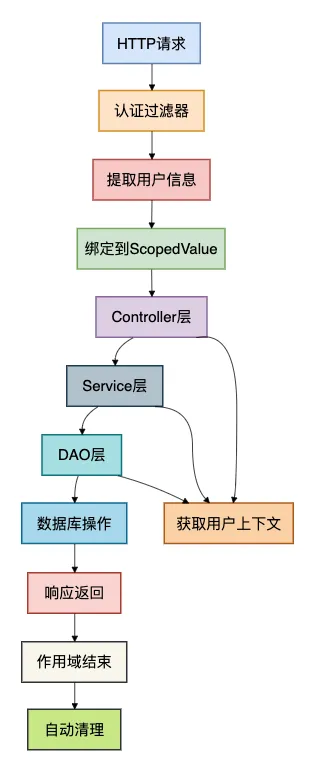
ScopedValue的生命周期如下图所示:

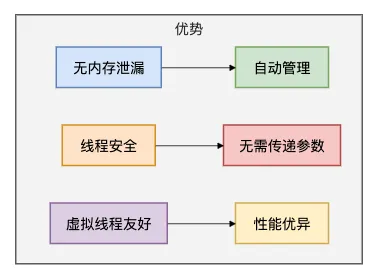
优势如下图所示:
5.1 定义Web应用中的ScopedValue
/** * Web应用ScopedValue定义 */ public class WebScopedValues { // 用户上下文 public static final ScopedValue<UserContext> USER_CONTEXT = ScopedValue.newInstance(); // 请求信息 public static final ScopedValue<RequestInfo> REQUEST_INFO = ScopedValue.newInstance(); // 数据库连接(可选) public static final ScopedValue<Connection> DB_CONNECTION = ScopedValue.newInstance(); // 追踪ID public static final ScopedValue<String> TRACE_ID = ScopedValue.newInstance(); } /** * 用户上下文详细信息 */ class UserContext { private final String userId; private final String username; private final List<String> roles; private final Map<String, Object> attributes; private final Locale locale; public UserContext(String userId, String username, List<String> roles, Map<String, Object> attributes, Locale locale) { this.userId = userId; this.username = username; this.roles = Collections.unmodifiableList(new ArrayList<>(roles)); this.attributes = Collections.unmodifiableMap(new HashMap<>(attributes)); this.locale = locale; } // Getter方法 public String getUserId() { return userId; } public String getUsername() { return username; } public List<String> getRoles() { return roles; } public Map<String, Object> getAttributes() { return attributes; } public Locale getLocale() { return locale; } public boolean hasRole(String role) { return roles.contains(role); } public Object getAttribute(String key) { return attributes.get(key); } } /** * 请求信息 */ class RequestInfo { private final String requestId; private final String method; private final String path; private final String clientIp; private final Map<String, String> headers; public RequestInfo(String requestId, String method, String path, String clientIp, Map<String, String> headers) { this.requestId = requestId; this.method = method; this.path = path; this.clientIp = clientIp; this.headers = Collections.unmodifiableMap(new HashMap<>(headers)); } // Getter方法 public String getRequestId() { return requestId; } public String getMethod() { return method; } public String getPath() { return path; } public String getClientIp() { return clientIp; } public Map<String, String> getHeaders() { return headers; } } 5.2 过滤器实现
/** * 认证过滤器 - 使用ScopedValue */ @Component @Slf4j public class AuthenticationFilter implements Filter { @Autowired private UserService userService; @Autowired private JwtTokenProvider tokenProvider; @Override public void doFilter(ServletRequest request, ServletResponse response, FilterChain chain) throws IOException, ServletException { HttpServletRequest httpRequest = (HttpServletRequest) request; HttpServletResponse httpResponse = (HttpServletResponse) response; // 生成请求ID String requestId = generateRequestId(); // 提取请求信息 RequestInfo requestInfo = extractRequestInfo(httpRequest, requestId); // 认证用户 UserContext userContext = authenticateUser(httpRequest); // 在作用域内执行请求处理 ScopedValue.runWhere( ScopedValue.where(WebScopedValues.REQUEST_INFO, requestInfo) .where(WebScopedValues.USER_CONTEXT, userContext) .where(WebScopedValues.TRACE_ID, requestId), () -> { try { chain.doFilter(request, response); } catch (Exception e) { log.error("请求处理异常", e); throw new RuntimeException("过滤器异常", e); } } ); // 作用域结束后自动清理所有ScopedValue log.info("请求处理完成: {}", requestId); } private String generateRequestId() { return "req_" + System.currentTimeMillis() + "_" + ThreadLocalRandom.current().nextInt(1000, 9999); } private RequestInfo extractRequestInfo(HttpServletRequest request, String requestId) { Map<String, String> headers = new HashMap<>(); Enumeration<String> headerNames = request.getHeaderNames(); while (headerNames.hasMoreElements()) { String headerName = headerNames.nextElement(); headers.put(headerName, request.getHeader(headerName)); } return new RequestInfo( requestId, request.getMethod(), request.getRequestURI(), request.getRemoteAddr(), headers ); } private UserContext authenticateUser(HttpServletRequest request) { String authHeader = request.getHeader("Authorization"); if (authHeader != null && authHeader.startsWith("Bearer ")) { String token = authHeader.substring(7); return tokenProvider.validateToken(token); } // 返回匿名用户 return new UserContext( "anonymous", "Anonymous User", List.of("GUEST"), Map.of("source", "web"), request.getLocale() ); } } 5.3 业务层使用
/** * 用户服务 - 使用ScopedValue */ @Service @Slf4j @Transactional public class UserService { @Autowired private UserRepository userRepository; @Autowired private OrderService orderService; /** * 获取当前用户信息 */ public UserProfile getCurrentUserProfile() { UserContext userContext = WebScopedValues.USER_CONTEXT.get(); RequestInfo requestInfo = WebScopedValues.REQUEST_INFO.get(); String traceId = WebScopedValues.TRACE_ID.get(); log.info("[{}] 获取用户资料: {}", traceId, userContext.getUserId()); // 根据用户ID查询用户信息 User user = userRepository.findById(userContext.getUserId()) .orElseThrow(() -> new UserNotFoundException("用户不存在: " + userContext.getUserId())); // 构建用户资料 return UserProfile.builder() .userId(user.getId()) .username(user.getUsername()) .email(user.getEmail()) .roles(userContext.getRoles()) .locale(userContext.getLocale()) .lastLogin(user.getLastLoginTime()) .build(); } /** * 更新用户信息 */ public void updateUserProfile(UpdateProfileRequest request) { UserContext userContext = WebScopedValues.USER_CONTEXT.get(); String traceId = WebScopedValues.TRACE_ID.get(); log.info("[{}] 更新用户资料: {}", traceId, userContext.getUserId()); // 验证权限 if (!userContext.getUserId().equals(request.getUserId())) { throw new PermissionDeniedException("无权更新其他用户资料"); } // 更新用户信息 User user = userRepository.findById(request.getUserId()) .orElseThrow(() -> new UserNotFoundException("用户不存在: " + request.getUserId())); user.setEmail(request.getEmail()); user.setUpdateTime(LocalDateTime.now()); userRepository.save(user); log.info("[{}] 用户资料更新成功: {}", traceId, userContext.getUserId()); } /** * 获取用户订单列表 */ public List<Order> getUserOrders() { UserContext userContext = WebScopedValues.USER_CONTEXT.get(); // 调用订单服务,无需传递用户ID return orderService.getUserOrders(); } } /** * 订单服务 */ @Service @Slf4j @Transactional public class OrderService { @Autowired private OrderRepository orderRepository; public List<Order> getUserOrders() { UserContext userContext = WebScopedValues.USER_CONTEXT.get(); String traceId = WebScopedValues.TRACE_ID.get(); log.info("[{}] 查询用户订单: {}", traceId, userContext.getUserId()); // 直接从ScopedValue获取用户ID,无需参数传递 return orderRepository.findByUserId(userContext.getUserId()); } /** * 创建订单 */ public Order createOrder(CreateOrderRequest request) { UserContext userContext = WebScopedValues.USER_CONTEXT.get(); String traceId = WebScopedValues.TRACE_ID.get(); log.info("[{}] 创建订单: 用户={}", traceId, userContext.getUserId()); // 创建订单 Order order = new Order(); order.setOrderId(generateOrderId()); order.setUserId(userContext.getUserId()); order.setAmount(request.getTotalAmount()); order.setStatus(OrderStatus.CREATED); order.setCreateTime(LocalDateTime.now()); Order savedOrder = orderRepository.save(order); log.info("[{}] 订单创建成功: {}", traceId, savedOrder.getOrderId()); return savedOrder; } private String generateOrderId() { return "ORD" + System.currentTimeMillis() + ThreadLocalRandom.current().nextInt(1000, 9999); } } 5.4 Controller层
/** * 用户控制器 - 使用ScopedValue */ @RestController @RequestMapping("/api/users") @Slf4j public class UserController { @Autowired private UserService userService; /** * 获取当前用户资料 */ @GetMapping("/profile") public ResponseEntity<UserProfile> getCurrentUserProfile() { // 无需传递用户ID,直接从ScopedValue获取 UserProfile profile = userService.getCurrentUserProfile(); return ResponseEntity.ok(profile); } /** * 更新用户资料 */ @PutMapping("/profile") public ResponseEntity<Void> updateUserProfile(@RequestBody @Valid UpdateProfileRequest request) { userService.updateUserProfile(request); return ResponseEntity.ok().build(); } /** * 获取用户订单 */ @GetMapping("/orders") public ResponseEntity<List<Order>> getUserOrders() { List<Order> orders = userService.getUserOrders(); return ResponseEntity.ok(orders); } /** * 异常处理 */ @ExceptionHandler({UserNotFoundException.class, PermissionDeniedException.class}) public ResponseEntity<ErrorResponse> handleUserExceptions(RuntimeException e) { // 可以从ScopedValue获取请求信息用于日志 String traceId = WebScopedValues.TRACE_ID.get(); log.error("[{}] 用户操作异常: {}", traceId, e.getMessage()); ErrorResponse error = new ErrorResponse( e.getClass().getSimpleName(), e.getMessage(), traceId ); return ResponseEntity.status(HttpStatus.BAD_REQUEST).body(error); } } /** * 错误响应 */ @Data @AllArgsConstructor class ErrorResponse { private String error; private String message; private String traceId; private long timestamp = System.currentTimeMillis(); } 六、迁移指南:从ThreadLocal到ScopedValue
有些小伙伴可能担心迁移成本,其实从ThreadLocal迁移到ScopedValue并不复杂。
6.1 迁移步骤
/** * ThreadLocal到ScopedValue迁移指南 */ public class MigrationGuide { // ThreadLocal定义(旧方式) private static final ThreadLocal<UserContext> TL_USER = new ThreadLocal<>(); private static final ThreadLocal<Connection> TL_CONN = new ThreadLocal<>(); private static final ThreadLocal<String> TL_TRACE = new ThreadLocal<>(); // ScopedValue定义(新方式) private static final ScopedValue<UserContext> SV_USER = ScopedValue.newInstance(); private static final ScopedValue<Connection> SV_CONN = ScopedValue.newInstance(); private static final ScopedValue<String> SV_TRACE = ScopedValue.newInstance(); /** * 迁移前:ThreadLocal方式 */ public void beforeMigration() { // 设置值 TL_USER.set(new UserContext("user_old")); TL_TRACE.set("trace_old"); Connection conn = null; try { conn = createConnection(); TL_CONN.set(conn); // 业务处理 processBusinessOld(); } catch (Exception e) { // 异常处理 } finally { // 必须手动清理 TL_USER.remove(); TL_TRACE.remove(); TL_CONN.remove(); if (conn != null) { closeConnection(conn); } } } /** * 迁移后:ScopedValue方式 */ public void afterMigration() { UserContext user = new UserContext("user_new"); String trace = "trace_new"; // 使用try-with-resources管理连接 try (Connection conn = createConnection()) { // 在作用域内执行 ScopedValue.runWhere( ScopedValue.where(SV_USER, user) .where(SV_TRACE, trace) .where(SV_CONN, conn), () -> { // 业务处理 processBusinessNew(); } ); // 自动清理,无需finally块 } catch (Exception e) { // 异常处理 } } /** * 业务处理 - 旧方式 */ private void processBusinessOld() { // 需要处理null值 UserContext user = TL_USER.get(); if (user == null) { throw new IllegalStateException("用户上下文未设置"); } Connection conn = TL_CONN.get(); if (conn == null) { throw new IllegalStateException("数据库连接未设置"); } String trace = TL_TRACE.get(); // 业务逻辑... System.out.println("处理用户: " + user.getUserId() + ", 追踪: " + trace); } /** * 业务处理 - 新方式 */ private void processBusinessNew() { // 在作用域内保证不为null UserContext user = SV_USER.get(); Connection conn = SV_CONN.get(); String trace = SV_TRACE.get(); // 业务逻辑... System.out.println("处理用户: " + user.getUserId() + ", 追踪: " + trace); } /** * 复杂迁移场景:嵌套ThreadLocal */ public void complexMigration() { // 旧方式:嵌套ThreadLocal TL_USER.set(new UserContext("outer_user")); try { // 内层逻辑 TL_USER.set(new UserContext("inner_user")); try { processBusinessOld(); } finally { // 恢复外层值 TL_USER.set(new UserContext("outer_user")); } } finally { TL_USER.remove(); } // 新方式:嵌套ScopedValue ScopedValue.runWhere(SV_USER, new UserContext("outer_user"), () -> { ScopedValue.runWhere(SV_USER, new UserContext("inner_user"), () -> { processBusinessNew(); // 使用内层值 }); // 自动恢复外层值 processBusinessNew(); // 使用外层值 }); } private Connection createConnection() { // 创建连接 return null; } private void closeConnection(Connection conn) { // 关闭连接 } } 6.2 兼容性处理
/** * 兼容性处理 - 逐步迁移 */ public class CompatibilityLayer { // 新代码使用ScopedValue private static final ScopedValue<UserContext> SV_USER = ScopedValue.newInstance(); // 旧代码可能还在使用ThreadLocal private static final ThreadLocal<UserContext> TL_USER = new ThreadLocal<>(); /** * 桥接模式:同时支持两种方式 */ public void bridgePattern() { UserContext user = new UserContext("bridge_user"); // 在新作用域内执行 ScopedValue.runWhere(SV_USER, user, () -> { // 同时设置ThreadLocal以兼容旧代码 TL_USER.set(user); try { // 执行业务逻辑(新旧代码都可以工作) processMixedBusiness(); } finally { // 清理ThreadLocal TL_USER.remove(); } }); } /** * 适配器:让旧代码使用ScopedValue */ public static class ThreadLocalAdapter { private final ScopedValue<UserContext> scopedValue; public ThreadLocalAdapter(ScopedValue<UserContext> scopedValue) { this.scopedValue = scopedValue; } public void set(UserContext user) { // 对于set操作,需要在适当的作用域调用 throw new UnsupportedOperationException("请使用ScopedValue.runWhere"); } public UserContext get() { try { return scopedValue.get(); } catch (Exception e) { // 如果不在作用域内,返回null(模拟ThreadLocal行为) return null; } } public void remove() { // 无需操作,ScopedValue自动管理 } } /** * 混合业务处理 */ private void processMixedBusiness() { // 新代码使用ScopedValue UserContext svUser = SV_USER.get(); System.out.println("ScopedValue用户: " + svUser.getUserId()); // 旧代码使用ThreadLocal(通过桥接设置) UserContext tlUser = TL_USER.get(); System.out.println("ThreadLocal用户: " + tlUser.getUserId()); // 两者应该相同 assert svUser == tlUser; } /** * 逐步迁移策略 */ public void gradualMigrationStrategy() { // 阶段1:引入ScopedValue,与ThreadLocal共存 // 阶段2:新代码使用ScopedValue,旧代码逐步迁移 // 阶段3:移除ThreadLocal,完全使用ScopedValue System.out.println("建议的迁移阶段:"); System.out.println("1. 引入ScopedValue,建立桥接"); System.out.println("2. 新功能使用ScopedValue"); System.out.println("3. 逐步迁移旧代码"); System.out.println("4. 移除ThreadLocal相关代码"); System.out.println("5. 清理桥接层"); } } 总结
经过上面的深度剖析,我们来总结一下ScopedValue的核心优势。
核心优势
- 内存安全:自动生命周期管理,彻底解决内存泄漏
- 使用简单:结构化绑定,无需手动清理
- 性能优异:专为虚拟线程优化,性能更好
- 并发友好:完美支持结构化并发和虚拟线程
迁移决策指南
有些小伙伴在迁移时可能犹豫不决,我总结了一个决策指南:
ThreadLocal vs ScopedValue 选择口诀
- 新项目:直接使用ScopedValue,享受现代特性
- 老项目:逐步迁移,先在新模块使用
- 性能敏感:ScopedValue在虚拟线程中表现更佳
- 内存敏感:ScopedValue无内存泄漏风险
- 团队技能:ThreadLocal更普及,ScopedValue需要学习
技术对比
| 特性 | ThreadLocal | ScopedValue |
|---|---|---|
| 内存管理 | 手动remove | 自动管理 |
| 内存泄漏 | 高风险 | 无风险 |
| 使用复杂度 | 高(需要try-finally) | 低(结构化绑定) |
| 性能 | 较好 | 更优(虚拟线程) |
| 继承性 | 需要InheritableThreadLocal | 自动继承 |
| 虚拟线程支持 | 有问题 | 完美支持 |
最后的建议
ScopedValue是Java并发编程的重要进步,我建议大家:
- 学习掌握:尽快学习掌握ScopedValue的使用
- 新项目首选:在新项目中优先使用ScopedValue
- 逐步迁移:在老项目中制定合理的迁移计划
- 关注生态:关注相关框架对ScopedValue的支持
最后说一句(求关注,别白嫖我)
如果这篇文章对您有所帮助,或者有所启发的话,帮忙关注一下我的同名公众号:苏三说技术,您的支持是我坚持写作最大的动力。
求一键三连:点赞、转发、在看。
关注公众号:【苏三说技术】,在公众号中回复:进大厂,可以免费获取我最近整理的10万字的面试宝典,好多小伙伴靠这个宝典拿到了多家大厂的offer。
更多项目实战在我的技术网站:http://www.susan.net.cn/project



![洛谷 P11345 [KTSC 2023 R2] 基地简化 题解](http://www.itfaba.com/wp-content/themes/kemi/timthumb.php?src=http://www.itfaba.com/wp-content/themes/kemi/img/random/1.jpg&w=218&h=124&zc=1)
