



一、导入所用库
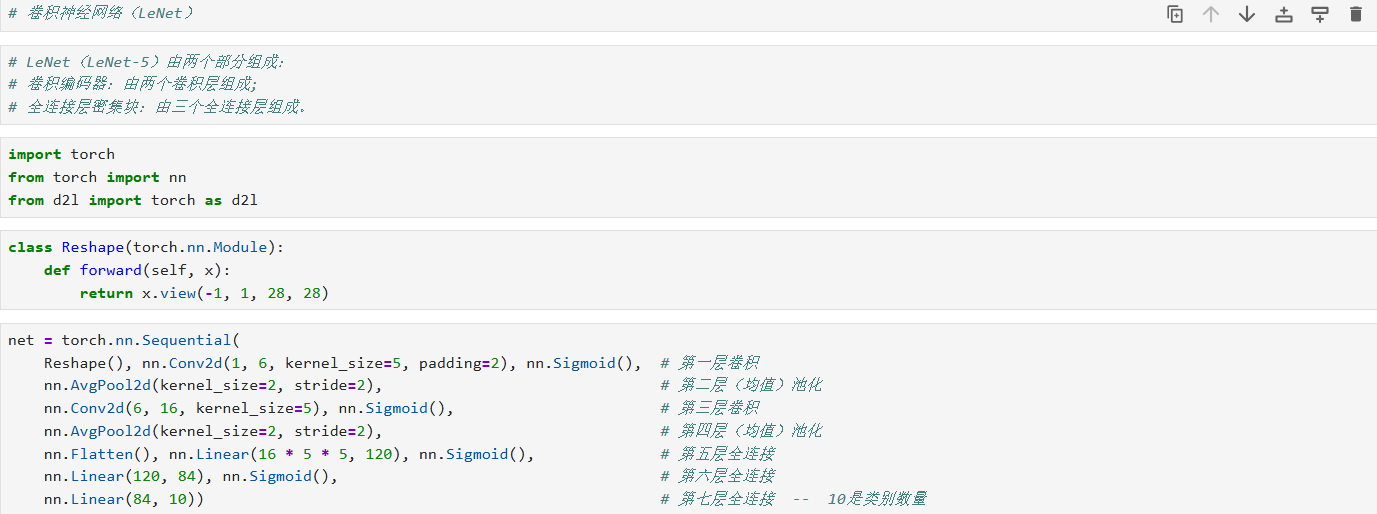
import torch from torch import nn from d2l import torch as d2l

二、自定义重塑层
class Reshape(nn.Module): def forward(self, x): return x.view(-1, 1, 28, 28)

三、构建 LeNet 网络

net = nn.Sequential( Reshape(), # 将输入 (batch, 784) → (batch, 1, 28, 28) nn.Conv2d(1, 6, kernel_size=5, padding=2), # 卷积层1:输入通道 1 → 输出通道 6,卷积核 5×5,padding=2 保持宽高不变 nn.Sigmoid(), # 激活函数:Sigmoid nn.AvgPool2d(kernel_size=2, stride=2), # 平均池化1:kernel=2, stride=2,下采样一半 nn.Conv2d(6, 16, kernel_size=5), # 卷积层2:6→16,kernel=5×5,默认无 padding → 尺寸缩小 nn.Sigmoid(), # Sigmoid 激活 nn.AvgPool2d(kernel_size=2, stride=2), # 平均池化2 nn.Flatten(), # 展平:把多维特征图拉成一维向量 nn.Linear(16 * 5 * 5, 120), # 全连接层1:输入 16×5×5 → 输出 120 nn.Sigmoid(), # Sigmoid 激活 nn.Linear(120, 84), # 全连接层2:120 → 84 nn.Sigmoid(), # Sigmoid 激活 nn.Linear(84, 10) # 输出层:84 → 10 类别 )

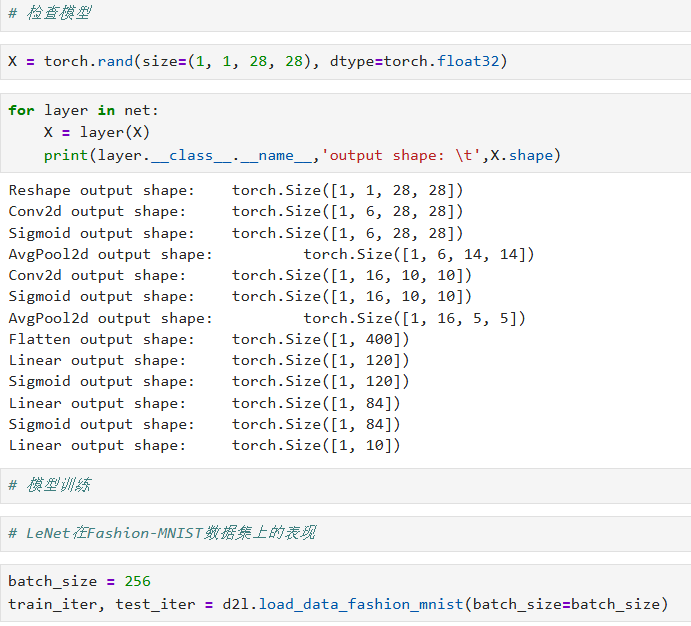
四、验证每层输出形状
X = torch.rand(size=(1, 1, 28, 28), dtype=torch.float32) for layer in net: X = layer(X) print(layer.__class__.__name__, 'output shape:t', X.shape) 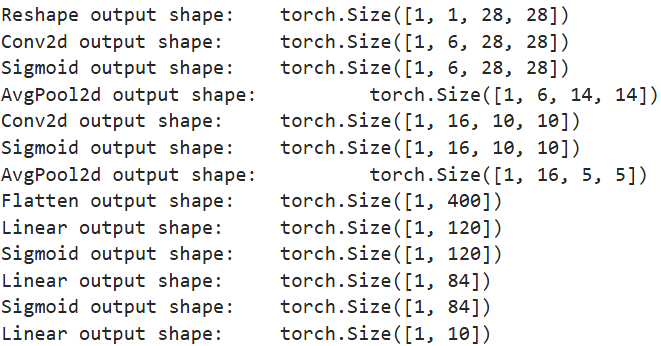

五、加载 Fashion-MNIST 数据
batch_size = 256 train_iter, test_iter = d2l.load_data_fashion_mnist(batch_size=batch_size)

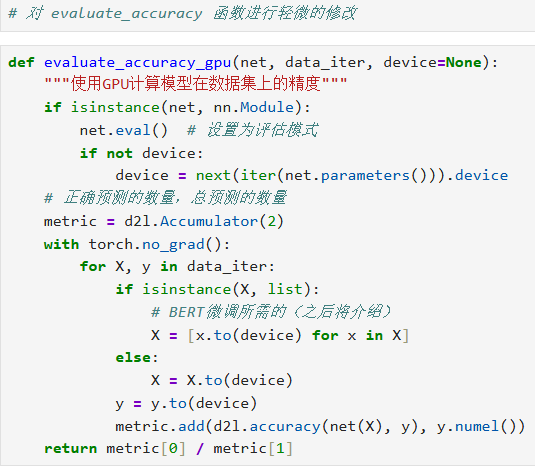
六、定义 GPU 下的准确率评估函数
def evaluate_accuracy_gpu(net, data_iter, device=None): """在 GPU 上评估模型在给定数据集上的准确率""" if isinstance(net, nn.Module): net.eval() # 切换到评估模式,关闭 dropout、batchnorm 等 if not device: device = next(iter(net.parameters())).device # metric[0] 累积正确预测数;metric[1] 累积样本总数 metric = d2l.Accumulator(2) with torch.no_grad(): for X, y in data_iter: X, y = X.to(device), y.to(device) y_hat = net(X) metric.add(d2l.accuracy(y_hat, y), y.numel()) return metric[0] / metric[1] 七、定义训练函数(带 GPU 支持)
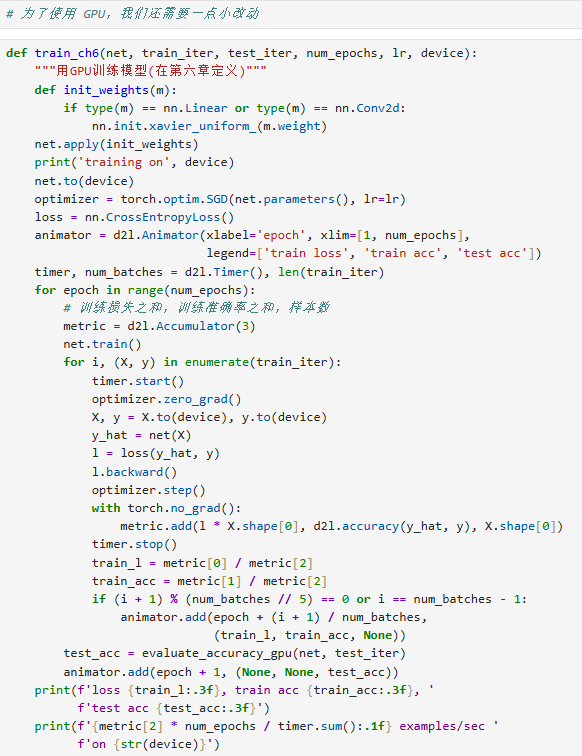
def train_ch6(net, train_iter, test_iter, num_epochs, lr, device): # 1. 权重初始化:对每个线性层和卷积层使用 Xavier 均匀分布初始化 def init_weights(m): if type(m) in (nn.Linear, nn.Conv2d): nn.init.xavier_uniform_(m.weight) net.apply(init_weights) print('training on', device) net.to(device) # 把模型参数搬到指定设备 optimizer = torch.optim.SGD(net.parameters(), lr=lr) loss = nn.CrossEntropyLoss() # 可视化工具:训练过程实时画图 animator = d2l.Animator(xlabel='epoch', xlim=[1, num_epochs], legend=['train loss', 'train acc', 'test acc']) timer, num_batches = d2l.Timer(), len(train_iter) # 2. 训练循环 for epoch in range(num_epochs): # 累积训练损失、训练正确预测数、样本数 metric = d2l.Accumulator(3) net.train() # 切回训练模式 for i, (X, y) in enumerate(train_iter): timer.start() X, y = X.to(device), y.to(device) optimizer.zero_grad() y_hat = net(X) l = loss(y_hat, y) l.backward() optimizer.step() with torch.no_grad(): metric.add(l * y.numel(), d2l.accuracy(y_hat, y), y.numel()) timer.stop() # 每训练完一个 epoch,或者到达最后一个 batch 时更新可视化 if (i + 1) % (num_batches // 5) == 0 or i == num_batches - 1: animator.add(epoch + (i + 1) / num_batches, (metric[0] / metric[2], metric[1] / metric[2], None)) # 每个 epoch 结束后计算一次测试集准确率并更新图示 test_acc = evaluate_accuracy_gpu(net, test_iter, device) animator.add(epoch + 1, (None, None, test_acc)) # 输出整体训练速度 print(f'{metric[2] * num_epochs / timer.sum():.1f} examples/sec on {device}')

八、运行训练
lr, num_epochs = 0.9, 10 train_ch6(net, train_iter, test_iter, num_epochs, lr, d2l.try_gpu()) 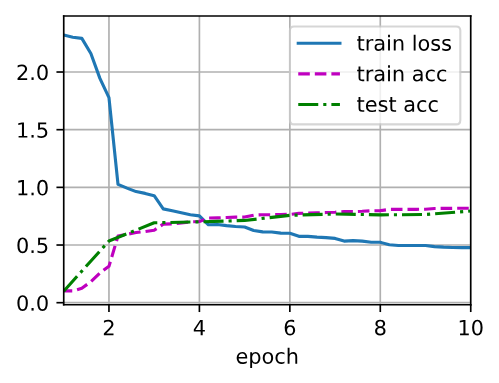

九、总结

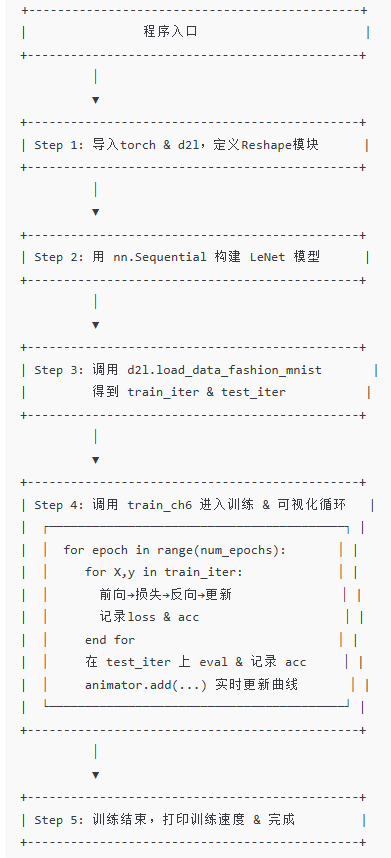
十、流程概览

1. 环境准备

2. 网络构建

3. 数据加载

4. 训练循环
for epoch in 1…N: for 每个 batch (X, y): 1) 前向计算 ŷ = net(X) 2) 计算损失 L = Loss(ŷ, y) 3) 反向传播 L.backward() 4) 优化器更新参数 optimizer.step() 5) 累积训练损失 & 正确率 end-for # 每跑完一个 epoch: - 在测试集上评估一次准确率 - 把训练损失、训练准确率、测试准确率推到“动画器”里,实时画图 end-for

5. 评估与可视化

6. 通俗小结




![洛谷 P11345 [KTSC 2023 R2] 基地简化 题解](http://www.itfaba.com/wp-content/themes/kemi/timthumb.php?src=http://www.itfaba.com/wp-content/themes/kemi/img/random/1.jpg&w=218&h=124&zc=1)
