

前言
书接上回,我们讨论了在.NET8中新增的UnsafeAccessor,并且通过UnsafeAccessor访问了私有成员,这极大的方便了我们代码的编写,当然也聊到了它当前存在的一些局限性,那么它的性能到底如何?我们今天就来实际测试一下。
测试代码
话不多说,直接上代码,本次测试代码如下:
using System.Linq.Expressions; using System.Reflection; using System.Reflection.Emit; using System.Runtime.CompilerServices; using BenchmarkDotNet.Attributes; using BenchmarkDotNet.Columns; using BenchmarkDotNet.Configs; using BenchmarkDotNet.Order; using BenchmarkDotNet.Reports; using BenchmarkDotNet.Running; using Perfolizer.Horology; [MemoryDiagnoser] [Orderer(SummaryOrderPolicy.FastestToSlowest)] public class AccessBenchmarks { public static readonly A TestInstance = new(); public static readonly Action<A, int> SetDelegate; public static readonly Func<A, int> GetDelegate; public static readonly PropertyInfo ValueProperty; public static readonly MethodInfo SetValueMethod; public static readonly MethodInfo GetValueMethod; public static readonly Func<A, int> GetValueExpressionFunc; public static readonly Action<A, int> SetValueExpressionAction; static AccessBenchmarks() { TestInstance = new(); ValueProperty = typeof(A).GetProperty("Value"); SetValueMethod = ValueProperty.GetSetMethod(); GetValueMethod = ValueProperty.GetGetMethod(); SetDelegate = CreateSetDelegate(); GetDelegate = CreateGetDelegate(); GetValueExpressionFunc = CreateGetValueExpressionFunc(); SetValueExpressionAction = CreateSetValueExpressionAction(); } [UnsafeAccessor(UnsafeAccessorKind.Method, Name = "get_Value")] static extern int GetValueUnsafe(A a); [UnsafeAccessor(UnsafeAccessorKind.Method, Name = "set_Value")] static extern void SetValueUnsafe(A a, int value); [Benchmark] public void UnsafeAccessor() { SetValueUnsafe(TestInstance, 10); var value = GetValueUnsafe(TestInstance); } [Benchmark] public void Reflection() { SetValueMethod.Invoke(TestInstance, new object[] { 10 }); var value = GetValueMethod.Invoke(TestInstance, new object[] { }); } [Benchmark] public void Emit() { SetDelegate(TestInstance, 10); var value = GetDelegate(TestInstance); } [Benchmark] public void ExpressionTrees() { SetValueExpressionAction(TestInstance, 10); var value = GetValueExpressionFunc(TestInstance); } [Benchmark] public void Direct() { TestInstance.Value = 10; var value = TestInstance.Value; } private static Action<A, int> CreateSetDelegate() { var dynamicMethod = new DynamicMethod("SetValue", null, new[] { typeof(A), typeof(int) }, typeof(A)); var ilGenerator = dynamicMethod.GetILGenerator(); ilGenerator.Emit(OpCodes.Ldarg_0); ilGenerator.Emit(OpCodes.Ldarg_1); ilGenerator.EmitCall(OpCodes.Call, SetValueMethod, null); ilGenerator.Emit(OpCodes.Ret); return (Action<A, int>)dynamicMethod.CreateDelegate(typeof(Action<A, int>)); } private static Func<A, int> CreateGetDelegate() { var dynamicMethod = new DynamicMethod("GetValue", typeof(int), new[] { typeof(A) }, typeof(A)); var ilGenerator = dynamicMethod.GetILGenerator(); ilGenerator.Emit(OpCodes.Ldarg_0); ilGenerator.EmitCall(OpCodes.Call, GetValueMethod, null); ilGenerator.Emit(OpCodes.Ret); return (Func<A, int>)dynamicMethod.CreateDelegate(typeof(Func<A, int>)); } private static Func<A, int> CreateGetValueExpressionFunc() { var instance = Expression.Parameter(typeof(A), "instance"); var getValueExpression = Expression.Lambda<Func<A, int>>( Expression.Property(instance, ValueProperty), instance); return getValueExpression.Compile(); } private static Action<A, int> CreateSetValueExpressionAction() { var instance = Expression.Parameter(typeof(A), "instance"); var value = Expression.Parameter(typeof(int), "value"); var setValueExpression = Expression.Lambda<Action<A, int>>( Expression.Call(instance, ValueProperty.GetSetMethod(true), value), instance, value); return setValueExpression.Compile(); } } public class A { public int Value { get; set; } } public class Program { public static void Main() { Console.WriteLine(AccessBenchmarks.TestInstance); var summary = BenchmarkRunner.Run<AccessBenchmarks>(DefaultConfig.Instance.WithSummaryStyle(new SummaryStyle( cultureInfo: null, // use default printUnitsInHeader: true, printUnitsInContent: true, sizeUnit: SizeUnit.B, timeUnit: TimeUnit.Nanosecond, printZeroValuesInContent: true, ratioStyle: RatioStyle.Trend // this will print the ratio column ))); } } 在测试代码中,我们使用了BenchmarkDotNet来进行测试,测试的内容包括:
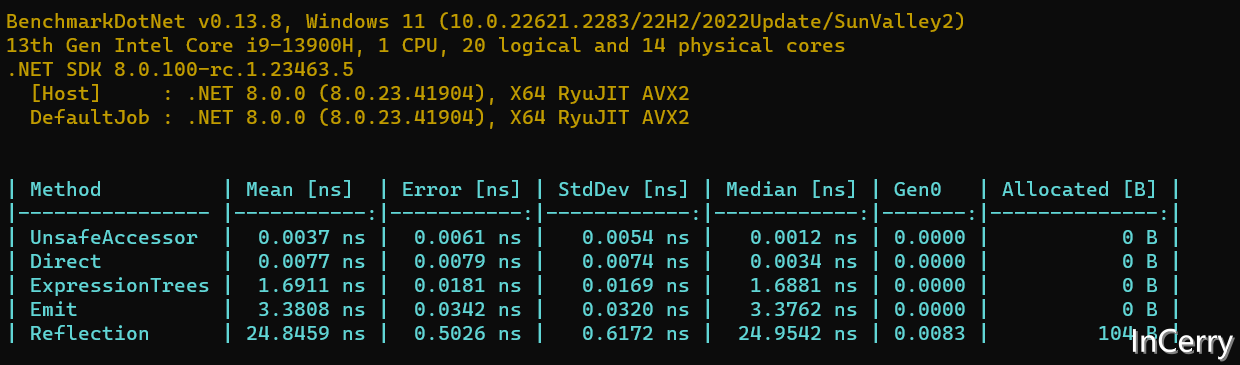
UnsafeAccessor:使用UnsafeAccessor特性来访问私有成员Reflection:使用反射访问私有成员Emit:使用Emit+动态方法访问私有成员ExpressionTrees:使用表达式树+委托来访问私有成员Direct:直接访问私有成员
测试结果如下图所示,可以看到使用UnsafeAccessor的性能是最好的,其次是直接访问私有成员,最差的是反射。这其实是出乎我的意料的,因为我认为它最多和直接访问私有成员的性能差不多,但是实际上它的性能比直接访问私有成员还要好,当然也有可能是统计的误差,0.0000ns这个尺度已经非常小了。

深入探究
看到这里我想大家都有很多疑问,实际上作者本人看到这里也是有很多的疑问,主要是这两个:
- 是什么原因让.NET社区想加入这个API?
- 它是如何做到访问私有成员的?
- 为什么性能会这么好?
新增功能的原因
如果要了解这个功能背后的东西,那么我们首先就要找到对应这个API的Issues,按照.NET社区的规范,所有的API都需要提交Issues,然后经过API Review,多轮讨论设计以后,才会开始开发。
首先我们定位到Issue是这一个,在Issue中我们可以了解到这个API主要是为了给System.Text.Json或EF Core这种需要访问私有成员的框架使用,因为目前它们都是基于Emit动态代码生成实现的,但是Emit不能在AOT中使用,现阶段只能使用慢速的反射API,所以迫切引入了一种零开销的私有成员访问机制。
https://github.com/dotnet/runtime/issues/86161
如何做到访问私有成员?
翻阅一下整个API提案Issue的讨论,我们可以找到具体实现的Issue,所以我们要了解它背后的原理的话,就需要跳转到对应的Issue。
在这里可以看到目前还没有做泛型的实现,非泛型的已经在下面链接中实现了,一个是为CoreCLR做的实现,另外一个是为Mono做的实现。

我们目前只关注CoreCLR,点开这个Issue。
https://github.com/dotnet/runtime/issues/86161

可以看到将这个任务拆成了几个部分,他们都在在一个PR中完成的,其中包括定义了UnsafeAccessor特性,在JIT中的实现,以及NativeAOT中进行了支持,另外编写了单元测试加入了有效的诊断方案。
那么来看看这个PR里面做了什么吧。
https://github.com/dotnet/runtime/pull/86932
由于PR非常的长,大家有兴趣可以点进去看看,低于8GB内存的小伙伴就要小心了。简单的来说这次修改主要就是两块地方,一块是JIT相关的修改,JIT这里主要是支持UnsafeAccessor和static extern int声明函数的用法,需要支持方法的IL Body为空,然后在JIT时根据特性为它插入代码。
首先我们来看JIT的处理,这块代码主要就是修改了jitinterface.cpp,可以看到它调用了TryGenerateUnsafeAccessor方法:

这个TryGenerateUnsafeAccessor方法实现在prestub.cpp中,这个prestub.cpp实现了一些预插桩的操作,TryGenerateUnsafeAccessor方法实现如下所示:

它针对UnsafeAccessorKind的不同枚举做了校验,防止出现运行时崩溃的情况:

然后调用了GenerateAccessor方法来生成IL:

在GenerateAccessor里面就是使用Emit进行代码生成:

所以从JIT的实现来看,它其实核心原理就是Emit代码生成,并没有太多特殊的东西。
另外是关于NativeAOT的实现,首先修改了NativeAotILProvider.cs这个类,这个类的主要作用就是在进行NativeAot的时候提供IL给JIT预先编译使用:

关键也是在GenerateAccessor方法里面,在这里生成了对应的IL代码:

总结一下,UnsafeAccessor实现原理还是使用的IL动态生成技术,只不过它是在JIT内部实现的。
为什么性能这么好?
那么它为什么性能要比我们在C#代码中自己写Emit要更好呢?其实原因也是显而易见的,我们自己编写的Emit代码中间有一层DynamicMethod的委托调用,增加了开销,而UnsafeAccessor它直接就是一个static extern int GetValueUnsafe(A a);方法,没有中间开销,而且它IL Body很小,可以被内联。
总结
通过对.NET8中新增的UnsafeAccessor特性的深入探究,我们得到了一些启示和理解。首先,UnsafeAccessor的引入并非无中生有,而是应运而生,它是为了满足System.Text.Json或EF Core这类框架在访问私有成员时的需求,因为它们目前大多基于Emit动态代码生成实现,但在AOT环境中无法使用Emit,只能依赖于效率较低的反射API。因此,UnsafeAccessor的引入,为我们提供了一种零开销的私有成员访问机制。
总的来说,UnsafeAccessor的引入无疑为.NET的发展增添了一抹亮色,它不仅提升了代码的执行效率,也为我们的编程方式提供了新的可能。我们期待在未来的.NET版本中,看到更多这样的创新和突破。



![洛谷 P11345 [KTSC 2023 R2] 基地简化 题解](http://www.itfaba.com/wp-content/themes/kemi/timthumb.php?src=http://www.itfaba.com/wp-content/themes/kemi/img/random/2.jpg&w=218&h=124&zc=1)
